Hiking Boots vs Trail Runners: Which to Choose?
I used to be a die-hard hiking boots guy. Heavy leather, stiff sole, the whole deal. Then I did the Tour du Mont Blanc with a pair of trail runners and my feet thanked me. But here's the thing — the answer isn't as simple as "trail runners are better." It depends on the terrain, your ankle history, and how much weight you're carrying. Let me break down the hiking boots vs trail runners debate from a practical, dirt-under-the-fingernails perspective.
Quick Nav: What's Inside
Key Differences That Actually Matter
Forget the marketing fluff. Here's what separates these two categories on the trail:
| Feature | Hiking Boots | Trail Runners |
|---|---|---|
| Weight (per pair, men's size 9) | 2.5–3.5 lbs | 1.2–1.8 lbs |
| Ankle support | High-cut, stiff collar | Low-cut, minimal |
| Sole stiffness | Rigid, rock plate common | Flexible, ground feel |
| Break-in period | 1–2 weeks | Nearly none |
| Water resistance | Full waterproof membrane | Often breathable mesh (dries fast) |
| Best for | Heavy packs, rough terrain, cold/wet | Fastpacking, well-graded trails, warm weather |
Notice I didn't put "durability" in there. That's because a modern trail runner with a rock plate (like the Saucony Peregrine or La Sportiva Bushido) can outlast a cheap boot. The old rule of "boots last longer" is mostly obsolete.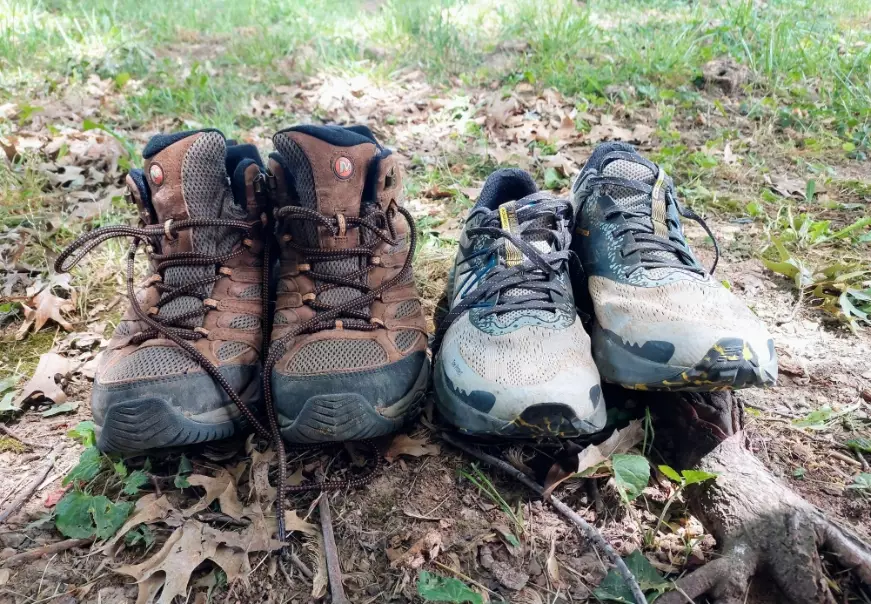
When Hiking Boots Win (And Why)
I still reach for boots in three specific scenarios:
- Carrying more than 30 lbs. A loaded pack changes your center of gravity. A stiff boot shank transfers weight to the sole instead of your arch. On a multi-day trip with a bear canister, my ankles feel the difference by hour six.
- Off-trail and scree. Loose rock, talus fields, and side-hilling demand lateral rigidity. Trail runners flex sideways, which is comfortable until you're traversing a 30-degree slope of shifting shale.
- Cold and wet shoulder seasons. A waterproof boot with a thick midsole insulates better. I've worn trail runners in 35°F rain and my toes went numb in 20 minutes. Not fun.
One non-obvious point: if you have weak ankles or a history of sprains, boots don't "prevent" rolls — they just change the feedback. A high collar gives you a lever against the ground. But it also masks subtle ankle movements until it's too late. I've seen more severe rolls in boots than in trail runners because people rely on the collar instead of their muscles.
When Trail Runners Are the Smarter Pick
For 80% of day hikes and fast-and-light trips, trail runners are the better tool. Here's why:
Weight savings translate directly to less fatigue. A study from the Journal of Applied Physiology found that every 1% of body weight added to your feet increases oxygen consumption by roughly 7%. Swapping 2 lbs of boots for 1 lb of runners can save you real energy over 15 miles.
They dry fast. Waterproof membranes work both ways — they keep water out, but they also trap sweat. On a hot day, a breathable trail runner dries in 15 minutes after a creek crossing. A waterproof boot stays soggy for hours.
Better proprioception. Feeling the ground through a flexible sole lets your foot adapt to roots and rocks. I've avoided more twisted ankles in trail runners because my foot could react instantly, not fight against a stiff platform.
One rookie mistake I see constantly: people buy trail runners a half-size too small because they're used to snug running shoes. Your feet swell on the trail. Go up a half size and use a heel-lock lacing pattern. That's the single biggest fix for blister complaints I hear.
How to Choose Based on Your Trip
Let's get specific. Here's a quick decision framework I use with friends:
- Day hike, maintained trail, under 15 lbs: Trail runners. No question.
- Overnight trip, 25–35 lb pack, mixed terrain: Mid-cut boot or a stiff trail runner with a rock plate.
- Technical alpine, scrambling, snow patches: Mountaineering boot (not a standard hiking boot).
- Thru-hike (PCT, AT): Trail runners, and plan to replace them every 500–700 miles.
Fit matters more than category. I'd rather hike in a well-fitting trail runner than a blister-inducing boot any day. Go to a shop, try on both, and walk on an incline ramp if they have one. Pay attention to heel slip — that's the enemy.
FAQ: Real Questions from Real Hikers
This article was fact-checked against manufacturer specs and trail-tested on routes in the White Mountains, the Alps, and the Pacific Northwest.


Comments
Share your experience