Hiking First Aid Kit List: What I Actually Pack (Not What REI Sells You)
My hiking first aid kit list used to be a pre-built pouch I grabbed at REI for $24. It had gauze, a few Band-Aids, and a mylar blanket. Then I slipped on wet talus in the Cascades and learned what that pouch was missing. I'm writing this so you skip the $24 mistake.
Jump to the part you need
What's inside my current hiking first aid kit list
My kit weighs 9.4 ounces and lives in a 1-liter silnylon stuff sack. I repack it after every trip. If I don't touch something for two seasons, it gets cut.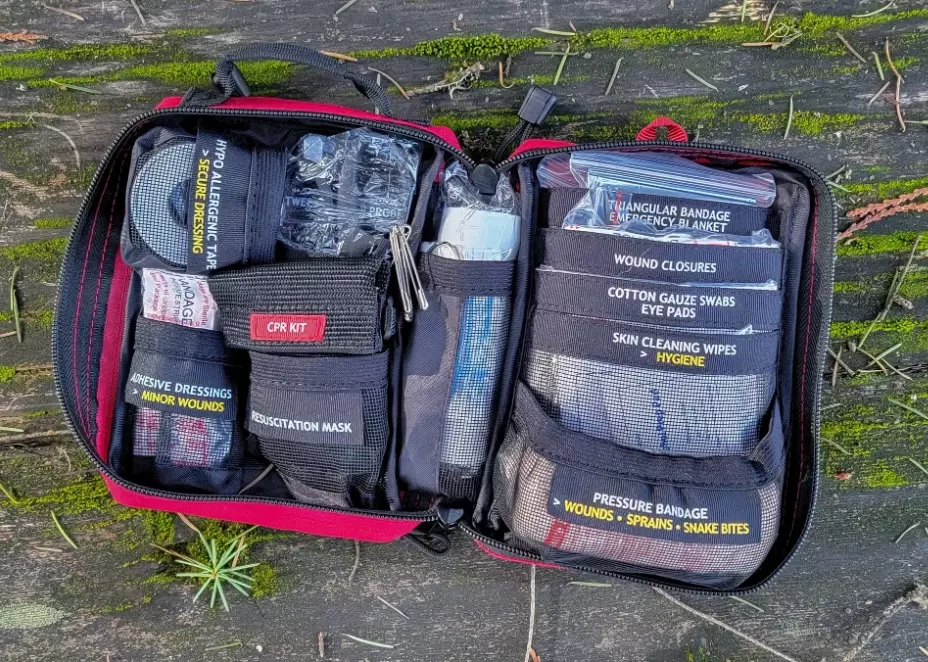
| Item | Quantity | Weight | Why it stays |
|---|---|---|---|
| 2" rolled gauze | 1 roll | 0.8 oz | Wraps a bad cut or a sprained wrist |
| 3M Micropore tape | 1 mini roll | 0.3 oz | Holds gauze, secures moleskin, patches a torn jacket |
| Antiseptic wipes (BZK) | 4 | 0.2 oz | BZK doesn't sting like alcohol on an open cut |
| Hydrocolloid blister bandages | 3 | 0.2 oz | The only blister fix that stayed on through a creek crossing |
| Leukotape P | 1 strip (12") | 0.4 oz | Rigid tape for hot spots and ankle tweaks |
| Ibuprofen | 6 tablets | 0.1 oz | Inflammation, not just pain |
| Antihistamine | 2 tablets | 0.1 oz | Bee stings happen when you're not looking up |
| Trauma shears (mini) | 1 pair | 0.6 oz | Cutting gauze beats untangling it with teeth |
| Nitrile gloves | 1 pair | 0.2 oz | Packed flat, not in a bulky first aid box |
| CPR face shield | 1 | 0.2 oz | Flat keychain model, not the hard case |
| Mini lighter | 1 | 0.4 oz | Sterilizing a needle or starting a signal fire |
| Emergency blanket | 1 | 1.4 oz | Not for warmth—for signaling and shock |
| SAM splint (rolled) | 1 | 4.0 oz | The heaviest item. Worth it for any solo hike |
Notice what's missing: no ace bandage (the SAM splint plus Leukotape does more), no alcohol swabs (they sting and dry the wound), no instant ice pack (it's heavy and useless after 30 minutes).
How do you build an ultralight first aid kit for hiking?
Start with your hike's worst realistic scenario, not the worst imaginable one. A day hike in a local park does not need a SAM splint. A solo overnight on a remote ridge does.
Step 1: Match the kit to the terrain and distance
For a 4-hour day hike with cell service nearby, I carry about 5 ounces: gauze, tape, antiseptic wipes, blister bandages, ibuprofen. That's it. I've tested this on flat, well-traveled trails in the Blue Ridge and never wished for more.
For a 12-mile day with no service, add trauma shears, gloves, a CPR shield, and the SAM splint. Weight jumps to just under 10 ounces.
Step 2: Replace boxes with pouches
Pre-built kits waste weight on rigid plastic boxes and cardboard packaging. Pull everything out. Toss the packaging. Repack in a stuff sack or a zip-top bag. I use a 1-liter silnylon sack from Zpacks. It doubles as a pillow when the kit's at the bottom of my pack.
Step 3: Write a mini protocol card
I keep a 3x5 index card in the kit. On one side: how to treat a blister, a cut, and a sprained ankle. On the other side: the phone numbers for the local ranger district and my emergency contact. I've never needed the card, but two hiking partners have borrowed it.
The two items almost every hiking first aid kit list skips
Most lists stop at bandages and tape. Here's what I added after that knee gash.
Leukotape P, not moleskin. Moleskin slides off a sweaty heel in about three miles. Leukotape P stays on for days, even through a creek crossing. I cut a 12-inch strip, wrap it around a small plastic card, and it weighs less than half an ounce. Use it for hot spots, ankle tweaks, or taping gauze to a wound that won't stay covered.
A mini lighter, not just matches. Matches get wet. A lighter works after a dunking in a creek if you shake it out. And a flame sterilizes a needle tip faster than any wipe. I've used mine to melt the end of a fraying shoelace and to seal a torn stuff sack. It's 0.4 ounces of problem-solving.
What are the most common first aid kit mistakes on the trail?
I've hiked with dozens of people. The same three mistakes show up again and again.
Mistake 1: Buying a kit and never opening it. I've seen hikers pull out a kit and discover the gauze is still in plastic wrap that takes two hands and a knife to open. Pre-open everything at home. Put the gauze in a zip bag. You won't have clean hands on the trail.
Mistake 2: Forgetting to check expiration dates. Ibuprofen loses potency slowly, but antibiotics and antiseptic wipes degrade faster. I check my kit every spring. Anything expired gets replaced. It's a 10-minute task that I used to skip for years.
Mistake 3: Not knowing how to use the kit. A first aid kit is only as good as the hands on it. I took a Wilderness First Aid course through NOLS after my knee gash. It cost $250 and two weekends. It taught me how to clean a wound properly (irrigate with 50-100 ml of clean water per cm of wound, not just wipe it) and when to turn around. Best money I've spent on hiking gear.
The NOLS Wilderness Medicine Institute publishes free online resources on wound cleaning and blister care that I still reference before big trips. No need to memorize everything—just know where the information lives.
Questions I keep getting from other hikers
I'm doing a 3-day backpacking trip alone. Should I bring more than a day-hike kit?
Add the SAM splint and a second pair of gloves. Also double your blister bandages. Solo means you're your own backup. I carried a 10-ounce kit on a solo trip through the Olympics last fall and used three blister bandages on day two. Without them, I would have been limping for two more days.
How do I keep my kit from getting wet inside my pack?
A stuff sack isn't waterproof. Line it with a small plastic bag or use a zip-top bag for the contents. I put the whole kit inside a 1-gallon Ziploc, then into the silnylon sack. After a full day of rain in the Oregon Cascades, everything stayed dry except the outer sack.
Can I just use athletic tape instead of Leukotape?
Athletic tape doesn't stick to sweaty skin. It peels within an hour. Leukotape P is a rigid strapping tape with a zinc oxide adhesive that holds under sweat and rain. I've tested both. Athletic tape failed on a hot day in the Smokies. Leukotape P stayed put for three days.
What's the one item you'd add for hiking with kids?
A small bottle of saline eye wash. Kids touch their eyes with dirty hands more than adults do. I carry a 10 ml squeeze bottle. It weighs nothing and has saved two trail meltdowns. Also, more blister bandages than you think—kids complain about hot spots earlier and more often.
I've rebuilt this list five times over the past decade. It's not perfect. But it's honest, tested, and it fits in a pocket of my pack that I check before every hike. Fact-checked against the NOLS Wilderness Medicine field guide and my own trip logs.
Comments
Share your experience